Before my daughter arrived, I understood space — but not yet from the perspective of an infant. A baby does not adapt to space. Space has to adapt to the baby.
I had studied it, taught it, designed it, even built it. But preparing a home for a baby made something very clear: space is something to touch, to bite, to hit, and to experience from the perspective of the floor. Doors become drums. Surfaces become landscapes. It is something we live through the body, every day, in a much more immediate way.
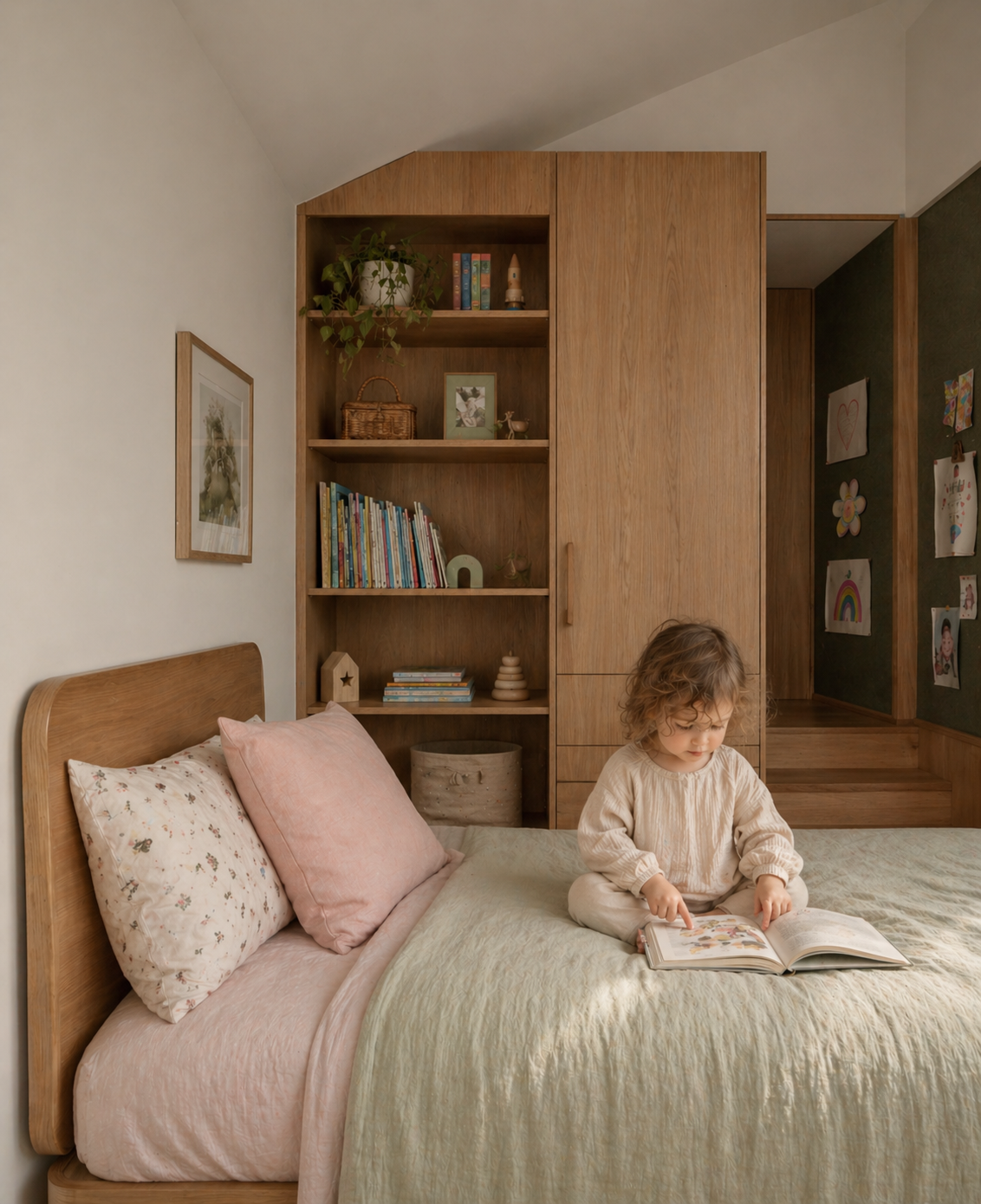
A baby does not see space the way we do. They understand it through the body — through reaching, turning, falling, hiding, returning. The home becomes a kind of first landscape. Not a designed nursery, but a field of small possibilities: a step to climb, a corner to disappear into, a door to open and close again. What matters is what the space allows — whether it invites movement, curiosity, and a sense of safety at the same time.
When a baby arrives, most attention goes to objects — the crib, the stroller, the bathtub. The space begins to fill quickly, almost defensively, as if more elements could create more control. But what research in neuroscience and developmental science consistently shows is that what truly shapes early life is the environment, not the objects.
A baby introduces a new rhythm. Sleep becomes fragmented, movement becomes slower and more careful, and the floor becomes as important as any piece of furniture. Light, sound, texture, and proximity become central. You start to notice things differently. Where you place your body when you hold the baby. How far the crib is from where you rest. How light enters the room in the early morning. How sound travels at night. Space becomes closer.
From the first days of life, the brain is not only developing — it is being shaped by experience, interaction, and space. Early development does not happen in isolation. It emerges from a continuous relationship between the baby, the caregiver, and the environment that holds them both. The home is an active system that participates in how life begins.
In Reggio Emilia pedagogy, the environment is called the third teacher — after the parent and the caregiver. Neuroarchitecture gives that idea a biological basis.
The infant brain is highly plastic, forming neural connections in response to repeated experiences. These experiences are physical and sensory: light entering a room, the rhythm of sound, the distance between bodies, the ease or difficulty of movement. I saw this in my daughter before I could name it — the way a particular quality of light would settle her, or a hard surface startle her. Over time, these conditions begin to organize how the nervous system regulates itself — how attention forms, and how the body learns to rest or remain alert.
This is why our home space cannot be understood as neutral. A chaotic or overstimulating environment requires the body to work harder — to filter, to adapt, to regulate continuously. A calm, legible environment, on the other hand, allows the body to settle. It reduces unnecessary effort and creates the conditions for development to unfold more naturally.
The home is not simply a setting for life. It is an active system that participates in how life begins.
Flexibility becomes more important than definition. Rooms that were once clearly assigned begin to overlap. The living room becomes a place for play. The bedroom becomes a place for feeding, resting, waiting. Boundaries soften, not by design, but by necessity.
And yet, this is precisely where design can make a difference. Preparing a space for a baby is not about creating a "baby room." It is about allowing the entire home to adapt. Small adjustments begin to matter more than large interventions. A chair placed in the right position can support long, quiet moments. A clear path through the space becomes essential when movement is constant and often done while carrying someone else.
Designing for health and pleasure.
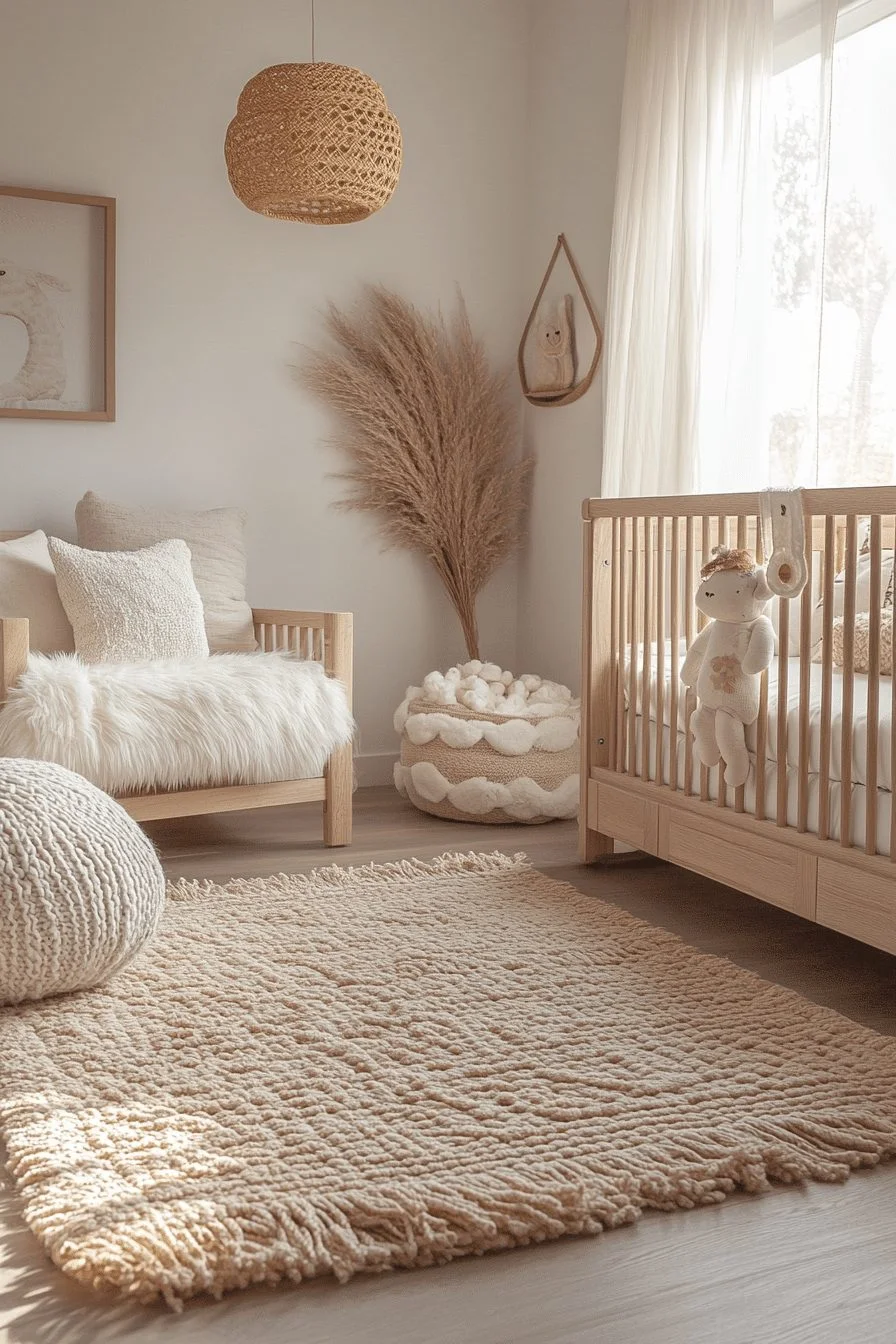
With a baby, the sensory qualities of the home take on a different significance. Light, sound, material, and temperature are inputs to a developing system — not background conditions. Esther Sternberg's research at the NIH demonstrates that natural light, softer acoustics, and clear spatial organization measurably reduce stress responses, while harsh lighting, constant noise, or visual clutter increase them. For a newborn, whose nervous system is still forming, these conditions are foundational.
Natural light regulates circadian rhythms and melatonin production in both mother and infant. Acoustic softness — achieved through textiles, nontoxic materials, and the absence of hard reflective surfaces — reduces the neurological load on a system that is processing everything for the first time. The smell of natural materials rather than synthetic finishes, the warmth of the room, the visual calm of neutral surfaces shape the developing nervous system.
Natural patterns — the grain of wood, the curve of a rocking arc, the fractals of a tree seen through a window are the forms the infant brain processes most easily. For a baby, a window is a first horizon.
A baby's first environment is not visual — it is chemical, tactile, and acoustic. Materials release substances into the air for months after installation. The goal is not purity, but reducing unnecessary load so development can unfold without interference. Through touch — warmth, grain, resistance — the world begins to take form.
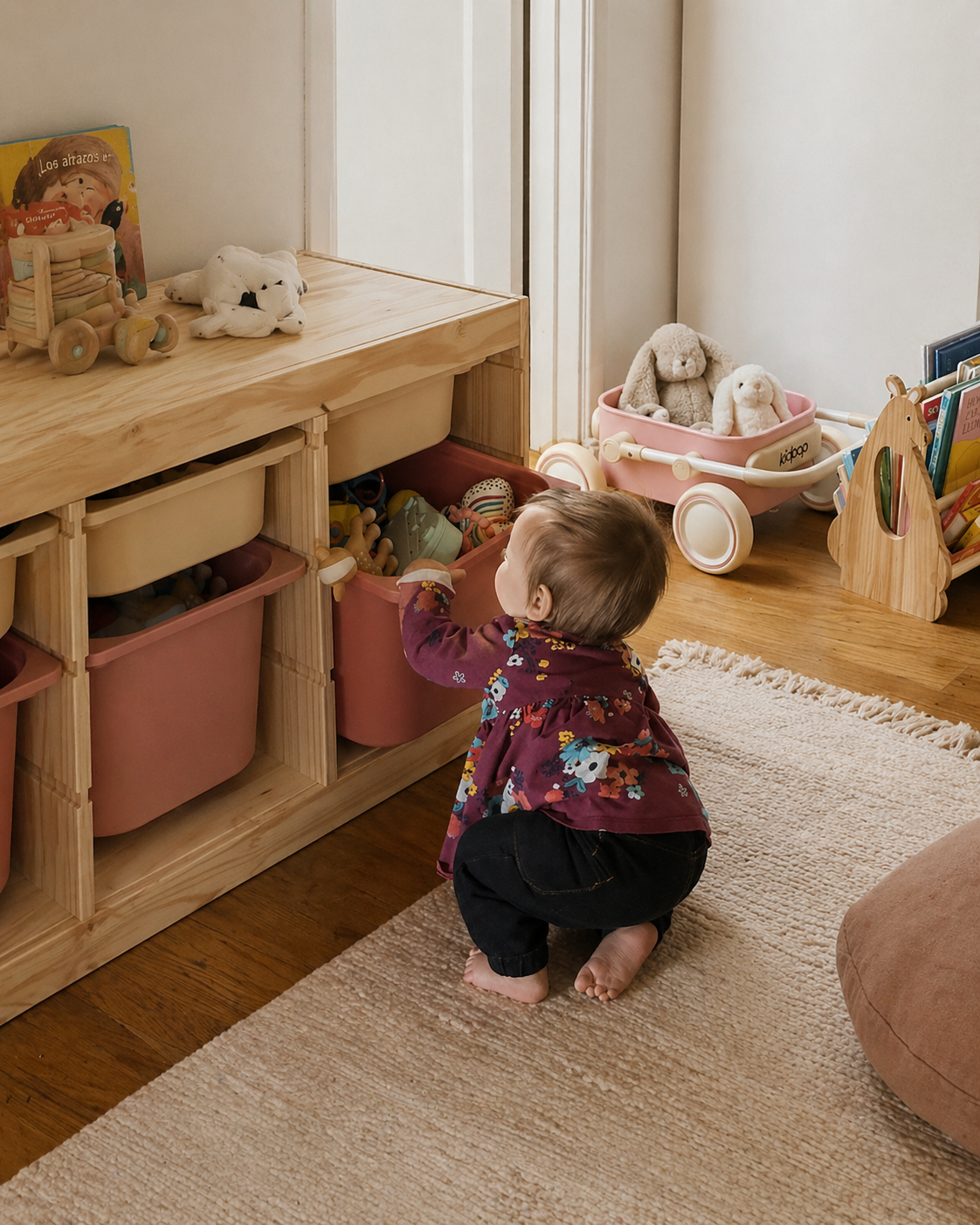
I was amazed by my daughter's fascination with the shadows of trees and vegetation moving across the walls, the entry of natural light, and its shifting reflections. It became her most engaging form of entertainment. She also shows an early love for color and art.
There is also a common assumption that more space provides more freedom. For infants, the opposite is often true. Undefined or overly expansive environments can disperse attention and create instability. What supports development is not the scale of space but its clarity — a defined, safe, and understandable environment where movement can happen without interruption and where exploration can be repeated. Boundaries, in this context, are not limitations. They are structures that allow freedom to emerge.
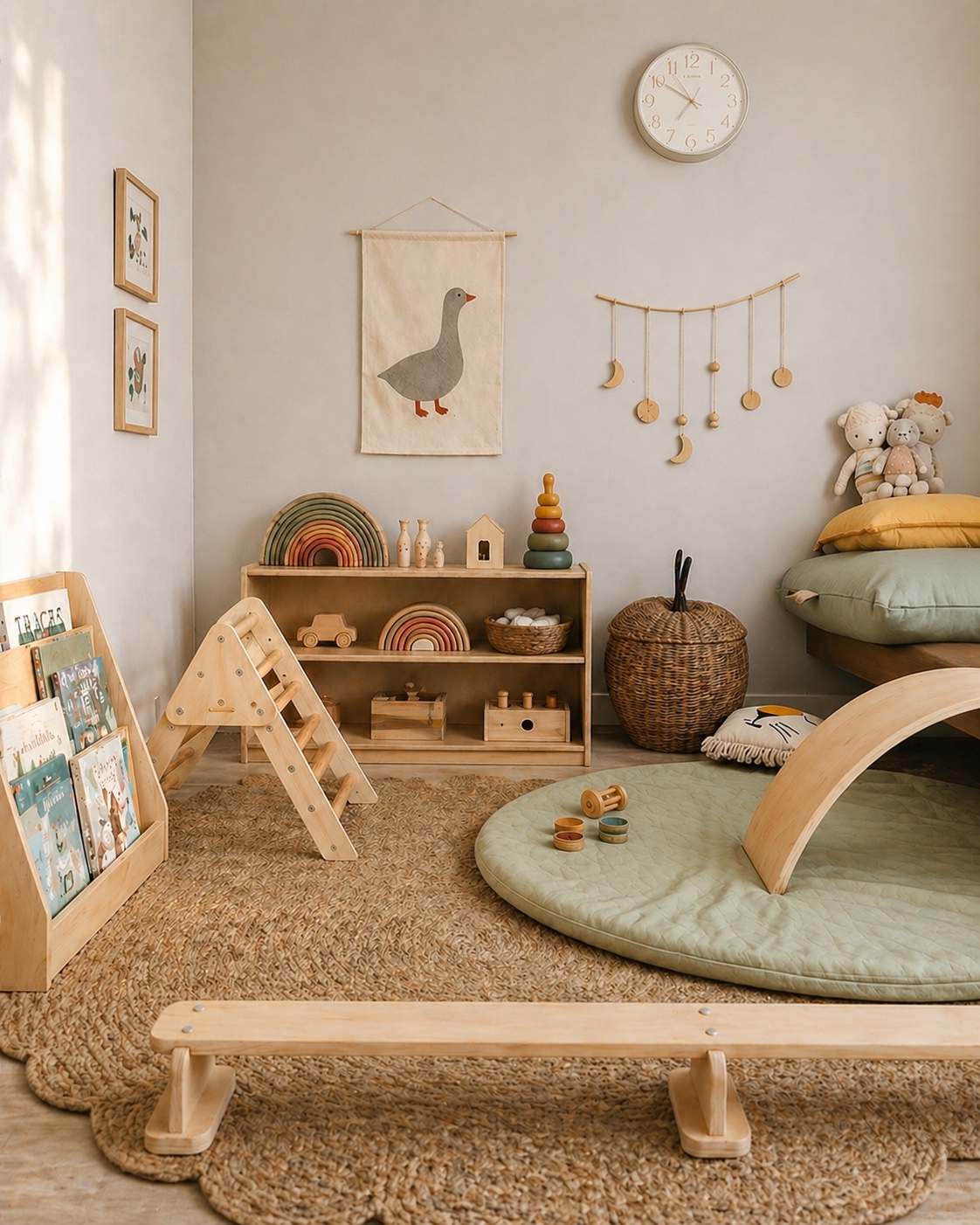
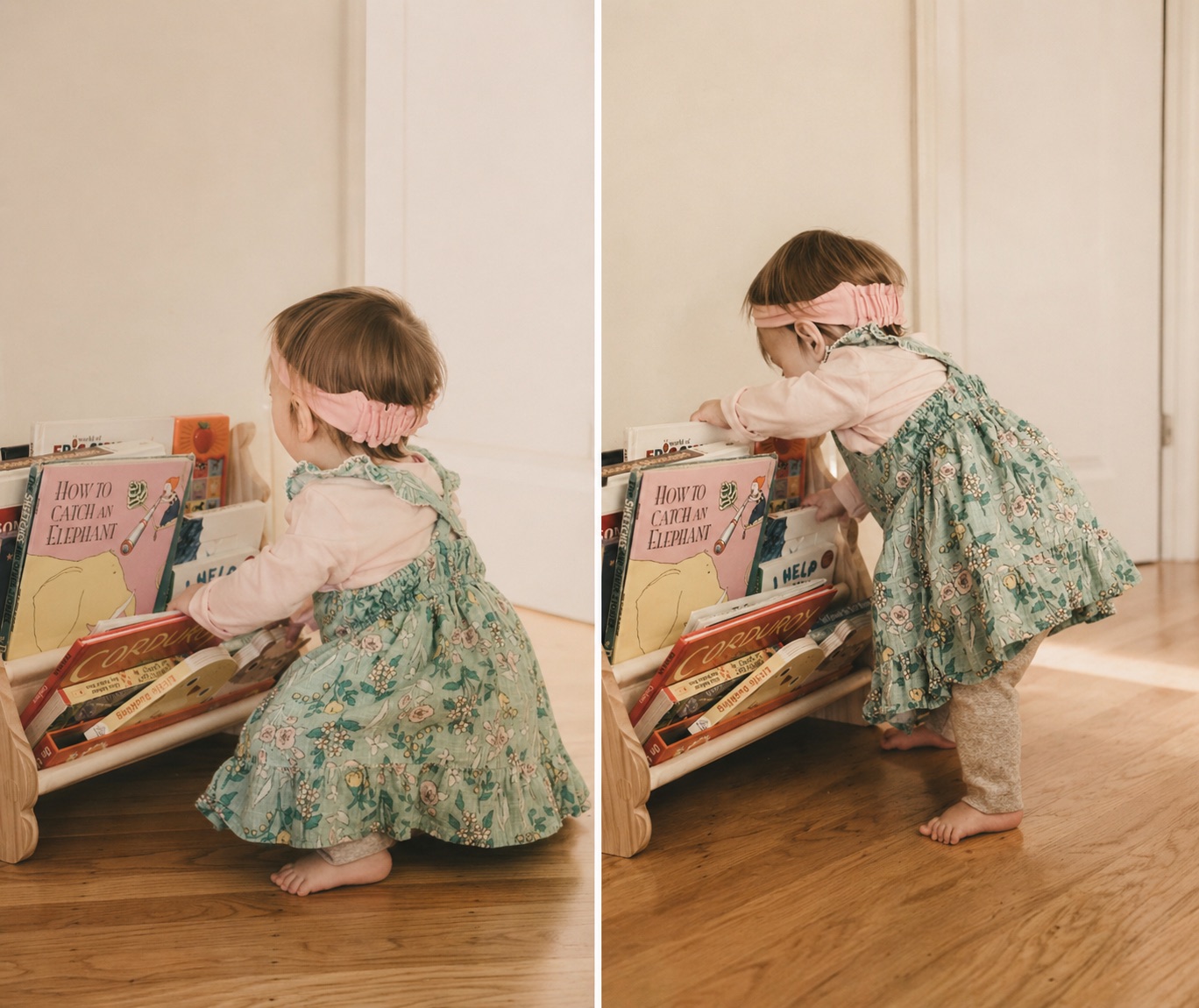
The Montessori approach to infant space makes this precise. A low shelf with two or three objects, a movement mat on the floor, a secured mirror at ground level — they place the infant at the center of a legible environment. One where the body can reach, discover, and return. Where rhythm — which is how early learning works — is possible without friction.
I noticed this when my daughter took over the entire house. Every threshold became interesting. Every hidden corner, a discovery. She looks for the edges, the in-between spaces — the corner between a chaise longue and a bed, the door that leads into a closet.
Design for a baby cannot be separated from design for the caregiver. The early months of parenthood are marked by fatigue, physical recovery, and constant attention. In this state, the environment has a direct impact on how manageable daily life becomes.
The distance between bed and bathroom. The position of a chair for feeding — whether it supports the back, the arms, the feet during a forty-minute nursing session at 2am. The availability of a surface to place a glass of water, a phone, a book. These are small decisions. But they accumulate. When poorly resolved, they create friction. When carefully designed, they disappear — allowing care to happen with less effort, and rest to be genuinely restorative.
The reproductive psychiatrist Alexandra Sacks describes the transition to motherhood as matrescence — a profound developmental shift in identity, as significant as adolescence, and almost entirely unacknowledged by the culture around it. The spatial implication is direct: a home designed only for the baby erases the mother. The unit of design is the dyad. Her rest, her visual access to the outside world, the continuity of her own aesthetic environment — these are not separate from her child's wellbeing. They are inseparable from it.
Order becomes a necessary luxury, and beauty a joy.
This also challenges the traditional idea of the nursery as a separate, dedicated space. Early life does not unfold in a single room. It moves across the home — through transitions, routines, and repeated paths. What matters is the relationship between spaces: how easily one moves from rest to care, from day to night, from one activity to another. The home operates as a sequence rather than a collection of rooms.
Access to natural light, fresh air, and views of the outside world matters throughout that sequence. For both the mother and the baby. Research consistently links natural light and visual access to nature with reduced cortisol, better sleep, and improved emotional regulation. A nursing chair facing a window is a considered health decision.
The dominant approach to preparing for a baby focuses on acquiring objects and equipment. A more grounded one focuses on conditions: proximity rather than separation, clarity rather than stimulation, continuity rather than fragmentation, support rather than effort.
A baby does not experience design visually. There is no perception of style or composition. What exists is the body, responding to what surrounds it. And in that response, the foundations of development are formed.
In the first year of life, space is not background. It is structure. It shapes how the body rests, how it moves, how it connects, and how it learns. A well-designed home at this stage is not minimal or maximal — it is precise. It reduces friction, supports proximity, regulates the senses, and allows life to unfold with greater ease.
Because at the beginning of life, more than at any other moment, what surrounds us shapes who we become.